 Wisteria [藤, fuji] is the name of a suit in traditional hanafuda decks. It is generally taken to be the fourth suit, representing the month of April [4月, shigatsu] or the number 4. In Korean, the suit is commonly called Black Bush Clover [흑싸리, heuk-ssari] instead.
The cards in this suit all feature hanging wisteria vines with clusters of purplish flowers. There are two Chaff cards, one Plain Ribbon, and one Animal. The Animal card of the Wisteria suit features a Cuckoo [不如帰, hototogisu] in front of a red (usually crescent) moon.
Due to its somewhat ambiguous appearance, this suit is also known by various alternative names in Japanese, including ‘Black Beans’ [黒豆, kuromame], ‘Blue Beans’ [青豆, aomame], and ‘Black Fruit’ [黒実, kuromi].
¶ Cards
¶ Cuckoo
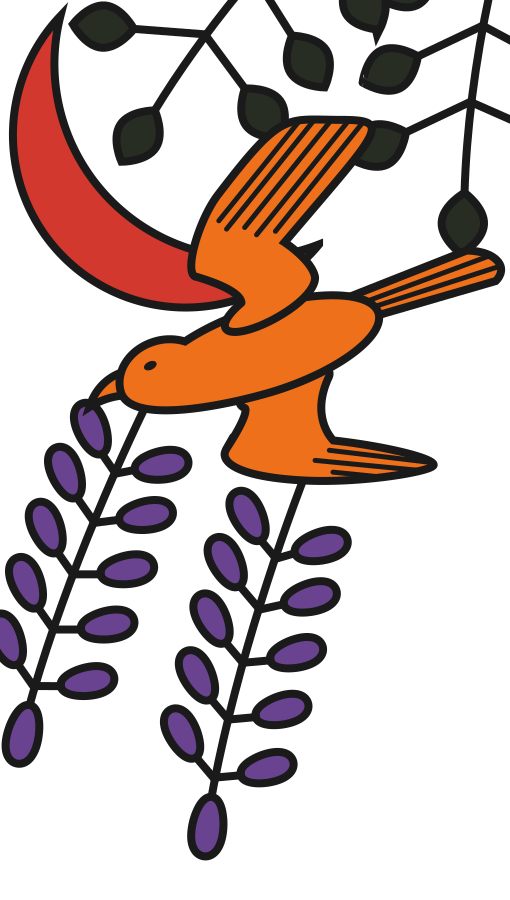 Wisteria with Cuckoo [藤に不如帰, fuji ni hototogisu],[1] or simply Cuckoo, is the animal card of the Wisteria suit.
In several Korean games such as Go-Stop, this card combines with the Bush Warbler and Geese to form the valuable “Five Birds” yaku. When captured alongside the other three Wisteria cards, it forms the “Wisteria Stripe” yaku in Hana-Awase, Mushi and in common variants of Roppyakken. In many other games, this card plays no particular role other than for making generic Animal yaku.
The red crescent moon is a relatively recent addition. Edo-period cuckoo cards did not have a background at all, and in the early Meiji era red clouds were added, which turned into a moon when the Hachi-Hachi-Bana pattern established itself.
¶ Plain Ribbon
 Wisteria with Ribbon [藤に短冊, fuji ni tanzaku] is the Ribbon card of the Wisteria suit.
This card combines with the Iris Ribbon and Bush Clover Ribbon to form the “Grass Ribbons” yaku in many games, including Hana-Awase, Roppyakken, and Go-Stop. In other games such as Koi-Koi and Hachi-Hachi it merely contributes to generic Ribbon yaku.
¶ Chaff

 The Wisteria suit, like most, has two Chaff cards.
In some older patterns such as echigobana each of these will feature half of the following waka poem, of dubious authorship.
| Japanese | Rōmaji | English |
|---|---|---|
| - | Waga yado no | The waves of wisteria by the pond |
| - | ike no huzinami | at my house |
| - | sakinikeri | have bloomed. |
| - | yama-hototogisu | Will the mountain cuckoo |
| - | ima ya konakan. | not come now? |
¶ Cultural significance
Cuckoos tend to migrate to Japan in the fourth month of the old lunar calendar (or around the start of May in the modern calendar), and their calls can first be heard when wisterias are in bloom. Because of this, wisterias and cuckoos have long been mentioned together in Japanese poetry about early summer. (On their own, wisteria is a seasonal word [季語, kigo] that indicates that a poem takes place in late spring or the third month of the lunar calendar, while the cuckoo indicates any summer month.)
Because wisterias are long-lived and can grow in poor soil, it was considered an auspicious plant. It is in the name and heraldry of the Fujiwara clan, the most powerful noble family in a lot of Japanese history. A lot of common Japanese family names still have the kanji for wisteria in them, often because they are descendants of the Fujiwara clan.
Several Japanese sources claim that the moon on the cuckoo card is a reference to the 81st poem of the Hyakunin Isshu anthology, by the poet Tokudaiji Sanesada. It reads “when I turned my gaze to where the cuckoo sung, all that remained was the morning moon.” Several English sources claim instead that it is a reference to the story of Yorimasa in the Heike Monogatari. When receiving his reward for slaying a monster, a cuckoo flies over and he composes a symbolic poem about a cuckoo and a crescent moon.
¶ Bibliography
- Fairbairn, John. “The Poems of the Echigobana.” Journal of the International Playing Card Society, Edited by Trevor Denning, XIV, no. 4, May 1986, pp. 97–102.
- Ōishi Tengudō, “花札の謎シリーズ!4月札『藤に杜鵑』,” blog post, December 2014.
- Rin & Char, “各月に描かれた絵柄の意味,” りんとちゃーの花しらべ, blog post, September 2019.
- Sazano Nozasa, “【花札の由来】4月「藤に不如帰(ほととぎす)」は春の終わりと夏の始まり?万葉集の一首から図柄を読む,” blog post, December 2025.
- Hanafuda Hawaii, “Symbols and Motifs in Hanafuda,” March 2025.
- Duarcain, The Twelve Suits of Hanafuda, blog post, September 2013.
- List of kigo and 季語一覧 (Kigo overview) on Wikipedia
¶ Footnotes
Hototogisu has many different spellings. In hanafuda, 不如帰 and 時鳥 are most common, but it may also be spelled in kana (ホトトギス or ほととぎす) or with various other kanji spellings, which include 杜鵑, 子規, and 郭公. ↩︎